

Neon signs speak of the past, connect the present, and point to the future in St. Robert, Missouri, where the Route 66 Neon Park lit up for visitors in 2025.
The vintage signs are authentic: They once stood along Route 66 between St. Louis and Carthage, and now have a new purpose in the park.
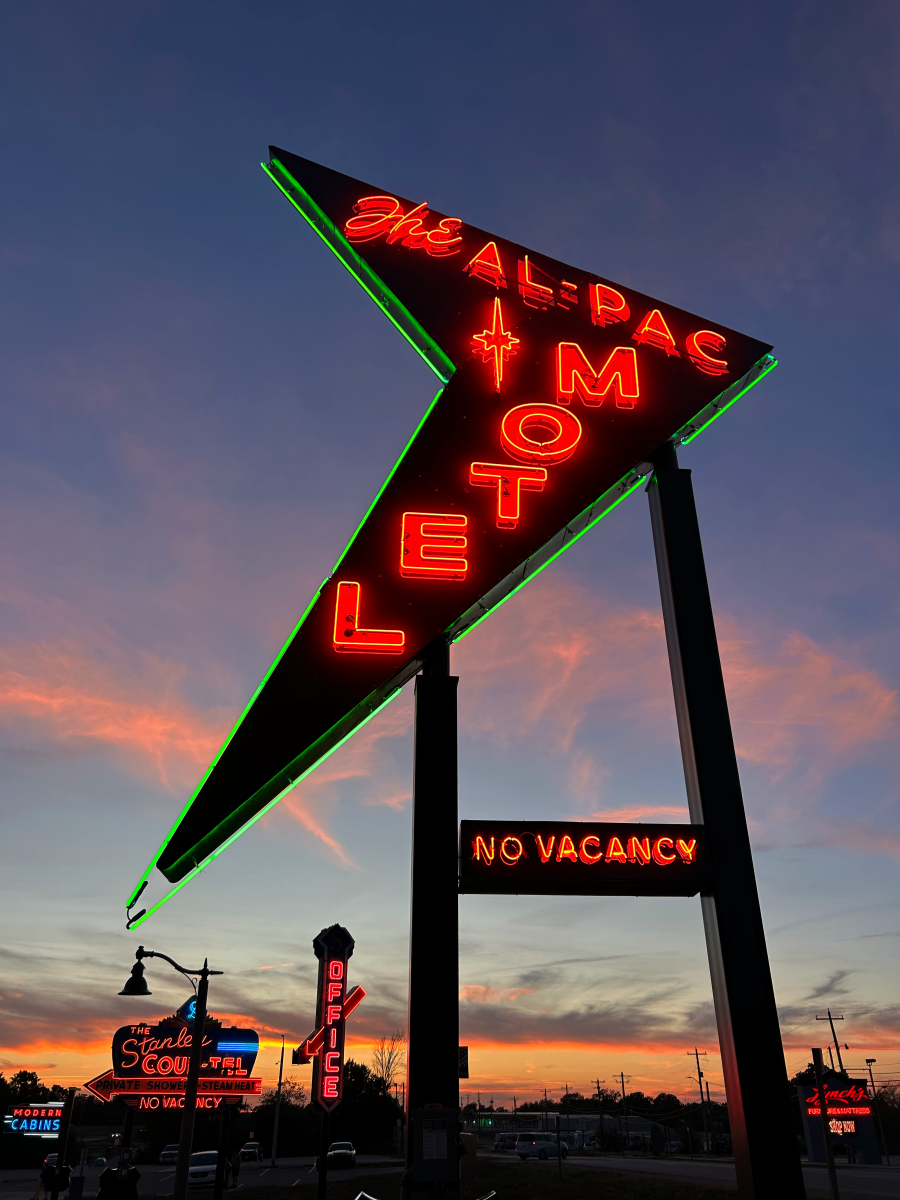
The Route 66 Neon Park features eight vintage signs that have been restored and now illuminate each night in the George M. Reed Roadside Park.
“Once left to decay in roadside fields, buried under piles of junk in dusty sheds or at risk of being dismantled, these beautifully crafted neon signs that once attracted travelers along the Mother Road have been given a new lease on life,” noted Pulaski County’s website. “Each sign has been meticulously restored to its mid-century modern glory and donated to the City of Saint Robert.”
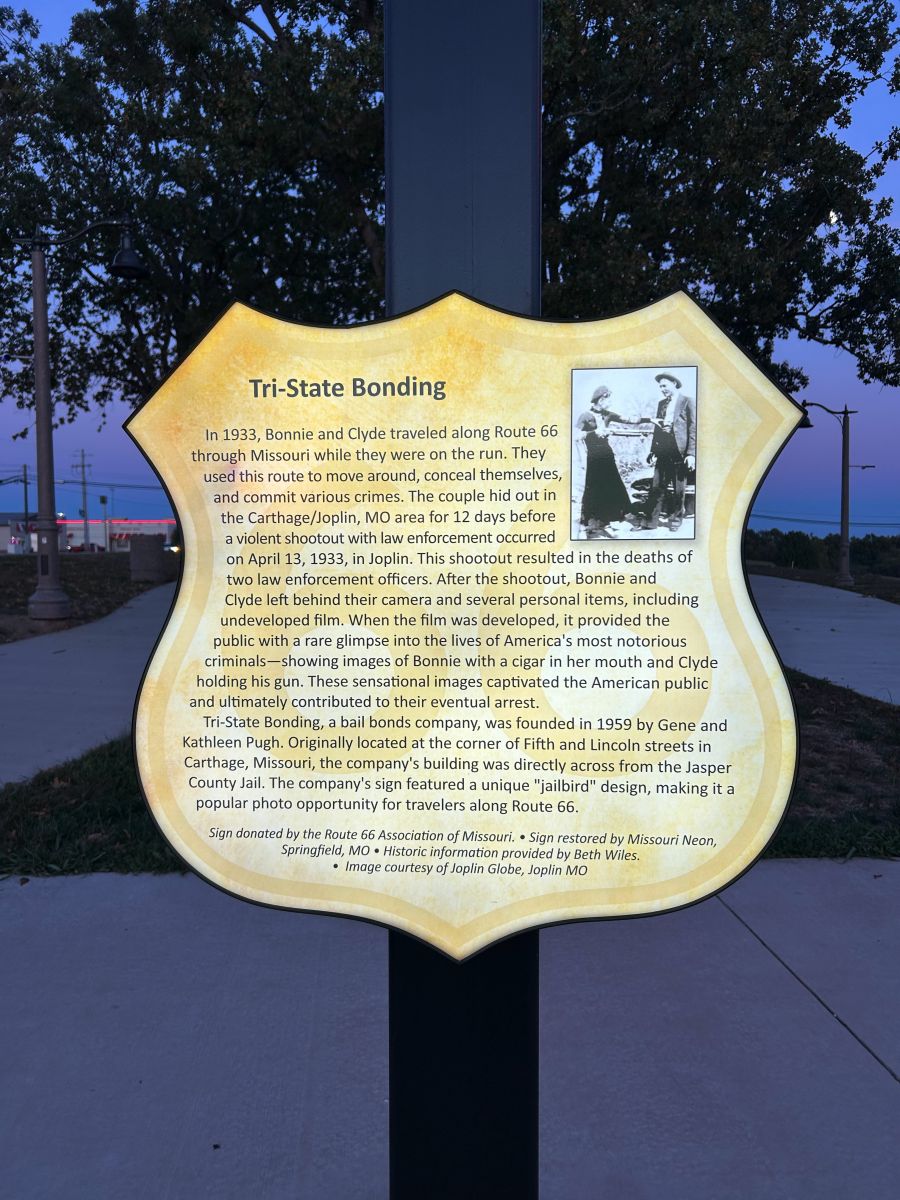
That list includes motels, a garage and even advertising a bail bondsman’s with flashing iron bars.
“Travelers love seeing these original signs lit up and glowing once again,” said Katie Dreadfulwater, executive director of the Pulaski County Tourism Bureau. “These signs were once seen from a distance while traveling and driving by, and now they are lit up in the park for all to enjoy up close and in person just as they should be, for they are all pieces of art.
“I think they capture the travelers’ attention because they are original pieces of the past that have come to life in the present,” she continued. “These are symbols of past travel and revive the sense of the true original road trip, getting out and hitting the open road in pursuit of exploration.”
How the park came to be
In addition to the signs and their stories, another layer to this history is the patch of ground where the signs glow. They’re at the George M. Reed Roadside Park, said to be one of the oldest continuously operating roadside park along Route 66, complete with original concrete picnic tables. It dates to the 1950s, the decade after nearby Fort Leonard Wood began in 1940.
Named for a local highway engineer, the park was made possible by the Waynesville Achievement Club, which solicited support from local businesses. A newspaper article listed at least some of them; most contributions were $5 or $10, and the biggest was $30 from Mooney Market.
The park was officially dedicated in June 1955, an event that per newspapers drew special guests including General Frank O. Bowman, commanding general of Fort Leonard Wood, Hon. Harris D. Rogers, chairman of the Missouri State Highway Commission, and Rex Whitton, chief engineer of the Missouri State Highway Commission.
“Everyone is urged to be present at the dedication and requested to bring their picnic baskets, including silverware,” noted the Pulaski County Democrat. “The club will furnish coffee for the occasion.”
Nearly 200 people attended that dedication, which, due to unfortunate weather, moved into the school cafeteria where “many tables of home made food were offered to guests,” noted the Democrat. “But after the affair, the club members drove out to inspect the park, and found that it was used all afternoon by tourists and servicemen.”
In an era of roadside stops, the park was part of a larger picture.
“The number of roadside parks along Missouri highways doubled between 1950 and 1957, and by 1968 there were more than 100,” noted Kip Welborn, a board member of the Route 66 Association of Missouri, in a 2026 article that appeared in papers across the state. “Missouri’s official highway maps in 1957 and 1958 highlighted these parks. The 1957 map listed 93 roadside parks and included a description emphasizing how they were distributed across the state ‘in proportion to the present demands of road users.’”
Today, many of those parks are gone. According to Welborn, in 1968, there were 101; by 2005, only 59 remained.
“In 2004, the Missouri Alliance for Historic Preservation listed Missouri’s roadside parks among the state’s ‘most endangered’ historic treasures,” he wrote.
A new dream begins to shine
When the Reed park began, Route 66 was just about 25 years old. Fast forward – past the route’s decline, decommissioning and renaissance to the cusp of its centennial – when the Route 66 Association of Missouri had the idea of starting a neon park.
“The brightly lighted, flashing signs had become affordable and ubiquitous at the height of popularity for the highway in the 1950s and 1960s, and had earned the road the nickname ‘Neon Highway,’” noted the St. Louis Post-Dispatch in 2025. “People traveling the route only had a few seconds to see a sign and decide to exit for small ‘mom and pop’ businesses, and the signs had proved effective in luring people off the highway.”
According to the St. Louis Post-Dispatch, a key moment in this idea was in 2013 at a National Park Service meeting in Los Angeles. Jim Thole of St. Louis was speaking on behalf of the Neon Heritage Preservation Committee of the Missouri Route 66 Association, and he introduced the idea of a neon park. Beth Wiles, then-director of the Pulaski County Tourism Bureau, was in the audience and immediately approached him after the speech, proposing a location.
“I held up my name badge, and when he saw where I was from, and before I could speak, he said, ‘Reed Park,’” Wiles recalled in the St. Louis paper in 2025.
That meeting of two Missourians half a continent away from home was fortuitous in retrospect, but it didn’t mean the St. Robert site was instantly chosen. As conversations progressed around the idea, it was one of three potential locations debated for the project, notes the City of St. Robert’s website, but was selected for a few reasons: “The centralized location within the state, the lay of the land, the approach to the property from both the east and west, and the unique median access to the park from both directions.”
The site was one question, and procuring the signs was another. Where to find vintage neon signs – and not just any examples, but ones specific to Route 66?
“The signs were donated by various community members, organizations, and some were found rusty, dusty, or abandoned and destined for the scrap heap,” said Dreadfulwater, who took over from Wiles as the county’s tourism leader in June 2026. “The only new sign is the St. Robert Neon Park entrance one. All the other signs have been restored as close to original as possible.”
The park officially lit up for the first time in May 2025.
“What a great crowd tonight at the grand opening and official lighting of the St. Robert Route 66 Neon Park,” noted a May 9 post on the Route 66 Neon Park’s Facebook page. “We had people from all over the state, nation, and the world (as we had a couple from Italy and from Australia stop in as they toured Route 66). The stories I heard as we talked with visitors to our city about how they remembered the signs when they were younger or hearing people talk about signs that were at their family’s business and were excited to see it reborn in our newest park. We are excited to see all who come visit our new tourist attraction.”
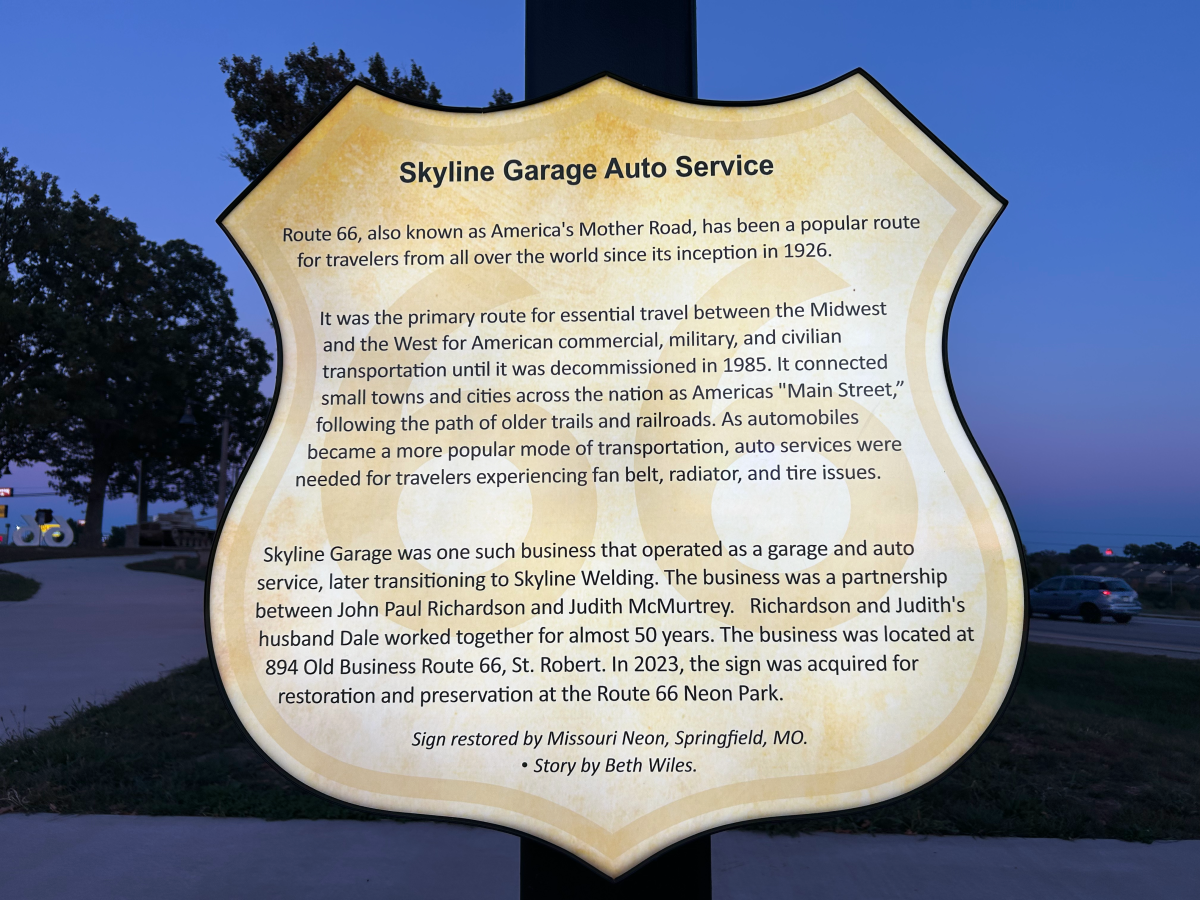
Currently, the park features eight vintage signs (and one new one that names the park) with room to grow. Each one includes a lighted “shield” at eye level that shares the sign’s history.
A few of its examples, with facts from the park’s website, include:
The Alpac Motel: “Formerly located east of Pacific, MO, this sign advertised the motel owned by Fred and Jean Miller, which was known as the ‘Home of Good Food.’”
The Alura Motel: “The lettering uses an uncommon style called “triple stroke,” with the letters outlined with an additional stroke of neon in the middle, creating a classic and highly visible calling card during its 66 heydays.”
Skyline Garage Auto Service: “Established as a business partnership between John Paul Richardson and Judith McMurtrey, Skyline Garage operated at 894 Old Business Route 66 in Saint Robert.”
Tri-State Bonding: “This bail bonds company was founded by Gene and Kathleen Pugh in 1959 at the corner of Fifth and Lincoln streets in Carthage, MO. The sign featured a unique ‘jail bird’ design — a popular photo op for Route 66 travelers — and was donated to Neon Park by the Route 66 Association of Missouri.”
Visitors are welcome to come see the signs whenever the park is open, which in 2026 is from sunrise until midnight. Signs are illuminated from each night from sunset until midnight, and during the winter are on in the morning from 5 a.m. to 7 a.m.
On a recent evening, a stream of visitors included groups taking selfies, a mom and young daughter on a girls night, and a woman who was traveling Route 66 in light of her birthday.
“I’m doing this because I’m 66 on 66,” said Margarete Smith of Texas, who stopped by the park. “This is a bucket list (item) for me.”
Those sorts of moments are ones Dreadfulwater said she hopes will continue past Route 66’s centennial year.
“The centennial has brought a whole new awareness of the classic road trip, the sense of slowing down and, enjoying the little things as you travel and making memories with your loved ones,” she said. “The Mother Road isn’t just to be celebrated this year but any time and by all ages. The essence of the classic Route 66 American road trip is something to be cherished and enjoyed by folks that may have traveled this road before and are reliving memories from times past, are for those that have never adventured before, and for those little ones who will travel as children and then bring their children and grandchildren to enjoy in it the future.”
Want to visit?
Learn more about the Route 66 Neon Park via Ozarks Alive. More information is also available here and here.
More Resources


Itineraries
Explore curated itineraries featuring attractions, dining, entertainment, and...
Visit Page