

The Shrine Mosque has been an Ozarks landmark since 1923. That year, work was complete on the towering downtown Springfield structure, which was — and is — home for the Abou Ben Adhem Shriners. Despite its name, the mosque has no religious affiliation, but was built as part of a national movement and as a complement to Springfield’s expected growth.
“All Southwest Missouri will be benefited by the mosque, it was said by local Shriners,” noted the Springfield Leader in February 1921. “The district will be able to see the largest attractions of the country, in addition to local pageants and attractions, at a low price because of the large seating capacity.”
More than a century later, it has built a place in the minds and memories of many through concerts and events held over the years.
“This is the largest building on all of Route 66 and it’s the only building left that’s still being used for what it was built for,” says Sam Montgomery, a Shriner who has been involved with the mosque since the 1970s. Like many others, his own memories of it go back to childhood, when he began attending the circus within its walls. “Most of the people are more blown away by what has happened in here than they actually are by the history of the building.

Sam Montgomery has been connected with the Shrine since the 1970s.
“This is our home.”
Keep reading to learn five quick-yet-important pieces of this local landmark’s story. If you’d like to learn even more, check out Ozarks Alive’s deep-dive from 2016.
The Shrine Mosque’s design ties to people and traditions far beyond the Ozarks
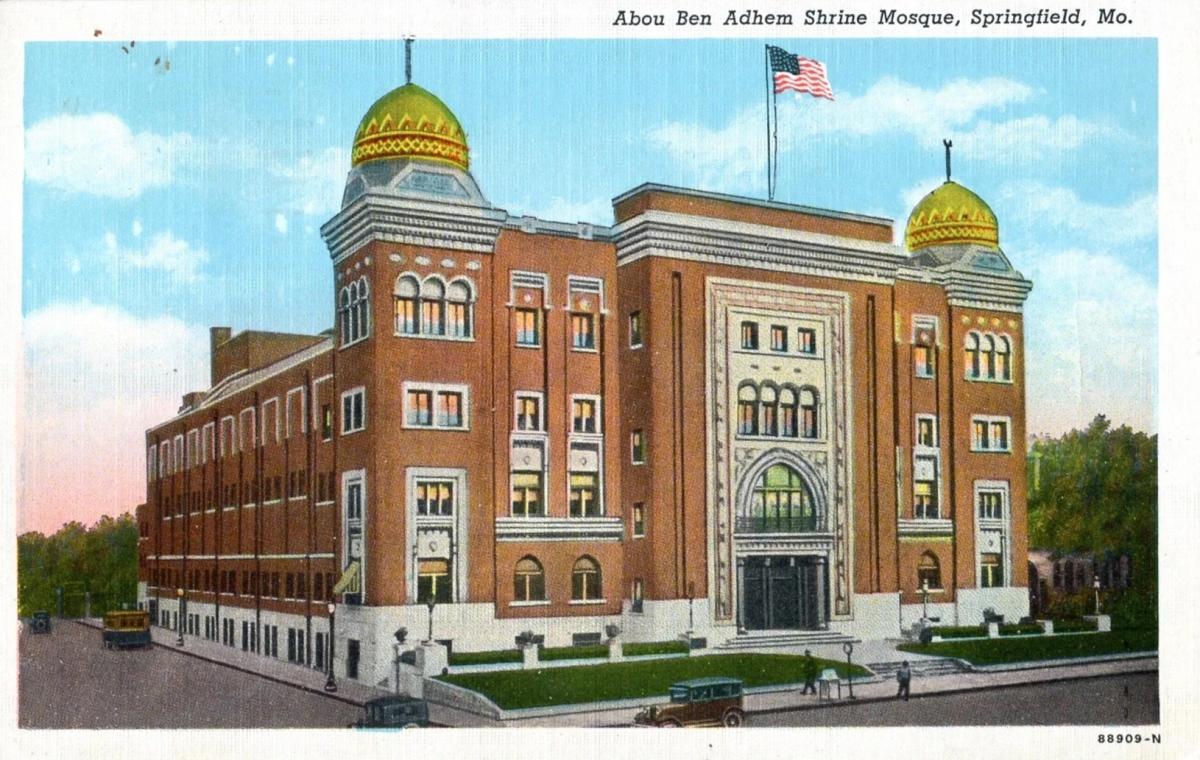
According to The Springfield Leader on May 16, 1926, "the architectural beauty of the huge (Shrine) mosque not only enhances the city, but the great auditorium has enabled various organizations to bring big conventions to the city."
Shriners International dates back to the 1870s, when a group of 13 Masons regularly met at the Knickerbocker Cottage in New York City. Two men – Dr. Walter Fleming and actor Billy Florence – were among the group that decided to create an even more exclusive society, one based around a party given by an Arabian diplomat.
As the Shriners’ website puts it: “The exotic style, flavors and music of the Arabian-themed party led Florence to suggest this as the theme of the new fraternity, while Dr. Fleming and other members of the group then drafted the ritual, designed the emblem and costumes, formulated a salutation and declared that members would wear the red fez.”
A number of related non-religious “mosques” were built across the country; Springfield’s is one that remains today.
“All of the buildings were built very similarly,” Montgomery says. “East St. Louis still has one; theirs is like this, but it’s a little bit smaller and not as fancy as this one.”
The Shrine Mosque’s completion was a huge moment for Springfield and the broader region

Work on the Shrine Mosque took nearly two years. This shot is from July 15, 1922, a few months short of the project's halfway point. (Courtesy of the Shrine Mosque)
Abou Ben Adhem — the Shrine “tribe” behind the mosque — originated in the early 1900s. Before the mosque was built, shriners met at a nearby Masonic Temple that today is home to Hotel Vandivort.
When local Shriners decided they needed a home of their own, plans went big. The Shrine Mosque has more than 4,500 seats, and a stage that would host big-time musicians and acts to draw tourists from throughout the region.
Springfield was headquarters for the Frisco Railway and the 1920s was a key moment in the Good Roads movement, so the Queen City was a place to go and people had better ways to get here.
“The size of the building and its exotic decoration and theme were especially notable at this time in Missouri's rugged and developing Ozark region,” notes the Shrine Mosque’s application for the National Register of Historic Places, to which it was added in 1982.
Work on the Shrine Mosque began in 1921, and took about two years to complete. It was dedicated in November 1923, an event that drew eight special trains with several thousand Shriners, noted the Springfield Leader the day before the mosque’s dedication.
Another paper put it this way:
“Not only is it a consummation to which all persons of Masonic affiliations may justly point with deepest pride, but it is something to challenge the admiration and the enthusiasm of every lover of progress in Southwest Missouri,” noted the Republican. “It is one of the noble structures of the country. It was conceived and carried forward along the broadest possible lines. Its completion is a triumph of bigness and boldness for the forces that dreamed and planned and finally brought it into actuality.
“This edifice makes it possible to bring the world’s greatest orators, singers, musicians and players within easy reach of the masses not only of Springfield but of all Southwest Missouri and Northern Arkansas. There is nothing else of like character in these regions to compare with it in the essentials of bigness and beauty and servicableness as a fraternal and artistic center. It means much, not only to the city, of which it is the crowning ornament, but to the entire community for a full hundred miles around.”
The Shrine Mosque has been a community hub for more than a century
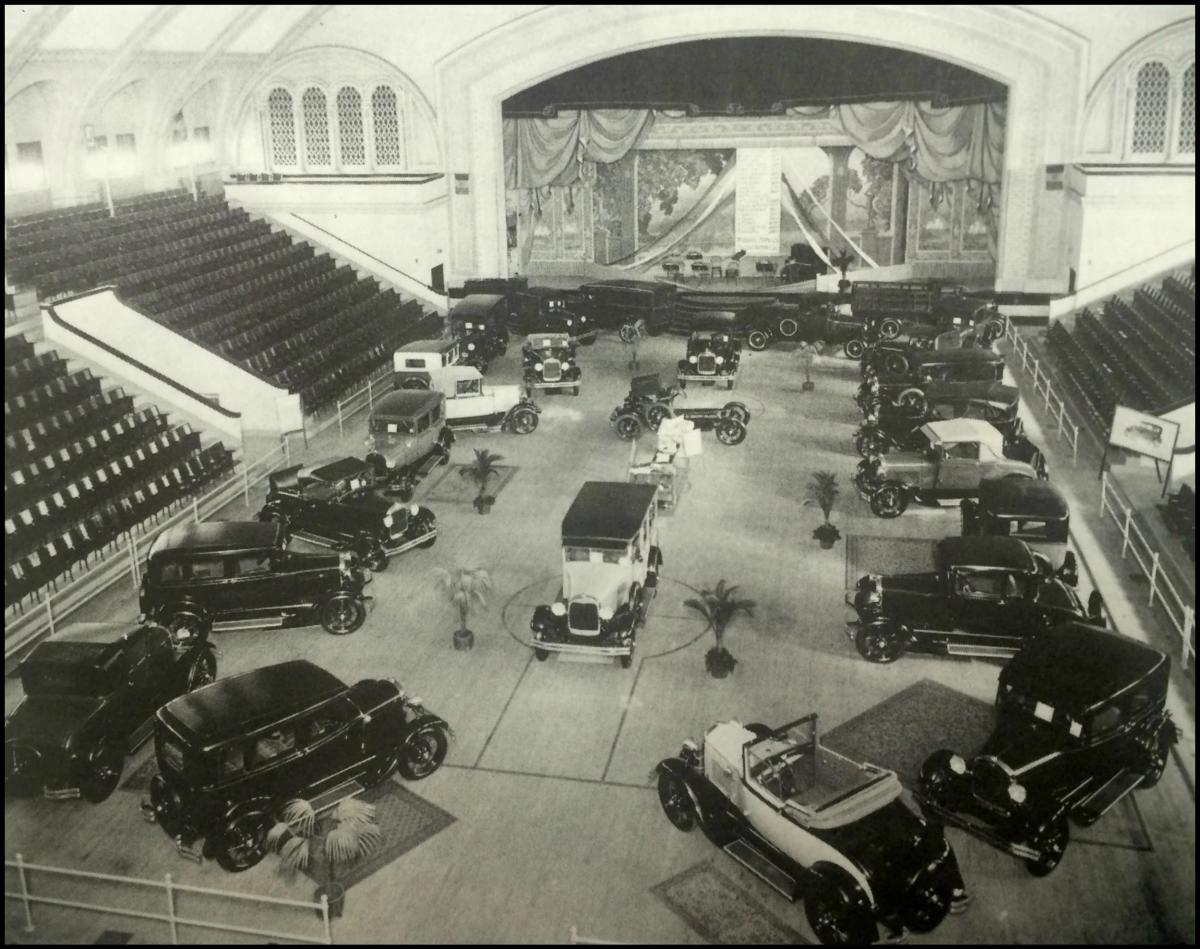
A car show at the Shrine Mosque circa 1930. (Courtesy of the Shrine Mosque)
From its start, the Shrine Mosque became a hub for local goings-on. Springfield had a Convention Hall down the street, but the mosque helped put it out of business as a wide-range of events were held within its walls.
Long before many other local venues came to be, it was a hub for concerts – more on those in a minute – as well as local shows like Korn's-A-Krackin', a precursor to the famed Ozark Jubilee TV show. For many years, it has become enshrined in children’s minds through the annual circus (which returns Feb. 12 - 15, 2026)
It was also a gathering place in times of community solidarity, like on D-Day during World War II.
In response to that news in June 1944, the mosque opened its doors for a community prayer service. The event, which was led by clergy representing local African Methodist Episcopal, Catholic, Jewish and Protestant congregations, was reported in the newspaper as emotional:
"Men, who cannot cry, children who do not quite understand, and women with heads bowed and handkerchiefs held to their eyes, were present. The men sat with their heads in their hands. Women cried softly and even the children were subdued and quiet."
Those events were able to happen because of community support. The Shriners lost the mosque during the Great Depression, but thanks to community support and fundraising — through the sale of bonds — they were able to soon reclaim the famed facility.
(As an aside: Given the Shrine Mosque’s age and size, maintenance is important and expensive. A great deal of the Shriners’ fundraising goes to support its hospitals, leading to the creation of a separate nonprofit that is dedicated to helping fund the building. The Shrine Mosque Preservation Association is designed “to preserve and restore the Historic Shrine back to its 1920s glory for continued use by the community and the Abou Ben Adhem Shriners,” its website notes.)
About those concerts: Elvis (and many other big-name celebrities) performed here
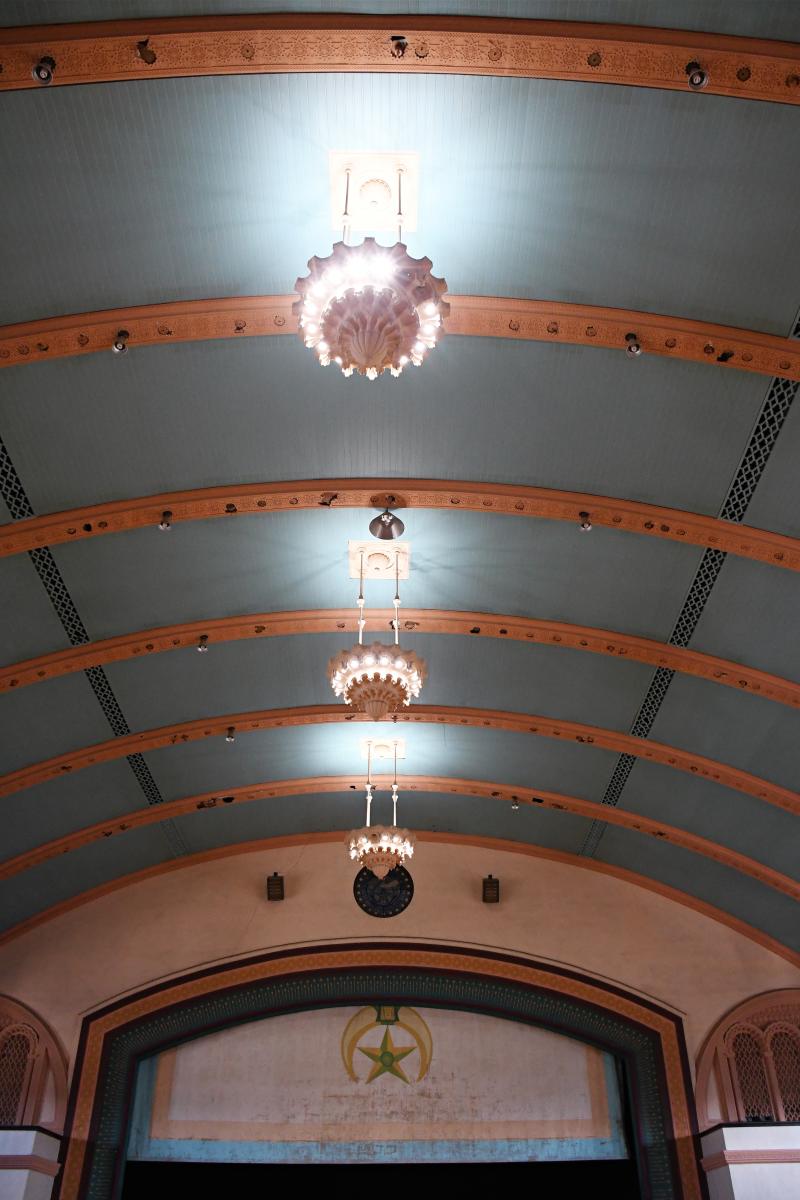
The Shrine Mosque is filled with unique details — including its stage curtain, which is original.
It’s a bit surreal to consider all of the big-name celebrities that have appeared at the Shrine Mosque.
“In addition to serving the charitable organization, the Mosque, which has the largest auditorium in southwest Missouri, has long served as a regional center for many and varied cultural and civic events,” notes its National Register application. “Everything from political and commercial conventions to wrestling matches, from concerts by Fritz Kreisler, Frank Sinatra and the U.S. Marine Band to performances by the Big Bands of Glenn Miller, the Dorsey Brothers and Benny Goodman, from speakers like Ronald Reagan to President Harry Truman to special attractions like Jose Greco and performances of ‘Afda’ and ‘Madame Butterfly’ have been welcomed here by southwest Missourians.”
Another name on that list: Elvis Presley.
Elvis performed at the Shrine Mosque in 1956, leading to an enduring piece of local lore. A young local boy named John Wilkinson snuck backstage and managed to find Presley’s dressing room where he visited with the star – and told him he was a terrible guitarist.
“Any other artist would have immediately thrown him out, but Elvis was intrigued,” notes a post by the History Museum on the Square. “He let Wilkinson play a few songs on his guitar, picking out a few notes from “Foggy Mountain Breakdown.” Security soon came storming in, but Presley didn’t insist that he be forcibly removed, saying he had just been given a guitar lesson. Wilkinson left voluntarily, but it wouldn’t be the last time that the two interacted.”
In an amazing twist of fate, Wilkinson later played rhythm guitar in Presley’s “Taking Care of Business” band. The Springfield native was also on stage when Presley made his second and final appearance in the Queen City in 1977.
Despite its Moorish look and feel, the Shrine Mosque was designed here in the Ozarks
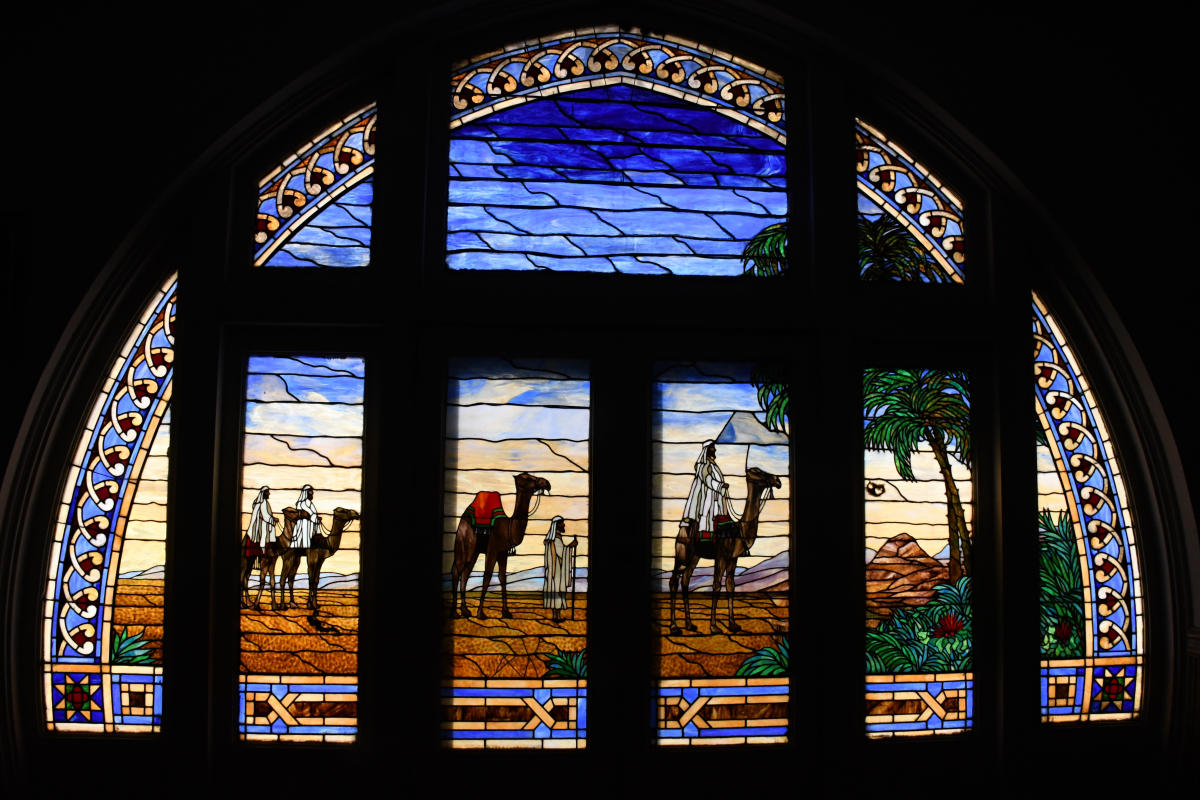
Stanley Uthwatt, an English immigrant who came to the Ozarks to work as a government railroad inspector, designed two stained glass windows that adorn the Shrine Mosque.
The Shrine Mosque’s design was created by Heckenlively and Mark, a Springfield architectural firm whose other works included Central High School’s fine arts building, Campbell and Weaver schools, and Harrison Football Stadium.
The building is filled with colors and intricate designs, and that many of its ornate details were created literally in the building, Montgomery says.
“Everything that’s in here was made here – it wasn’t something that they (brought in),” Montgomery says, pointing to just one example: An eight-foot-tall stained glass emblem in the auditorium. “It’s all hand-done,” he says.
That work of art — as well as a scene of travelers that overlooks St. Louis Street — was crafted by Stanley Uthwatt, an English immigrant who came to the Ozarks to work as a government railroad inspector.
This career came after he trained in the art of stained glass in England (and spent time with the Tiffany Company in New York City), newspaper accounts note. He was responsible for a number of Springfield’s stained glass windows in this era.
“The making of the windows, all of which has been done by hand in the local glass works, has required more than two years, Mr. Uthwatt said,” noted the Republican. “Glass in which the colors are composed of minerals — fused in the glass in the making and which are imperishable — are utilized in the windows. No paint or enamel kiln-burnt glass is used. The work is a revival of a method which has not been generally used for more than five centuries, Mr. Uthwatt said.”
The Shrine Mosque witnessed the birth of Route 66
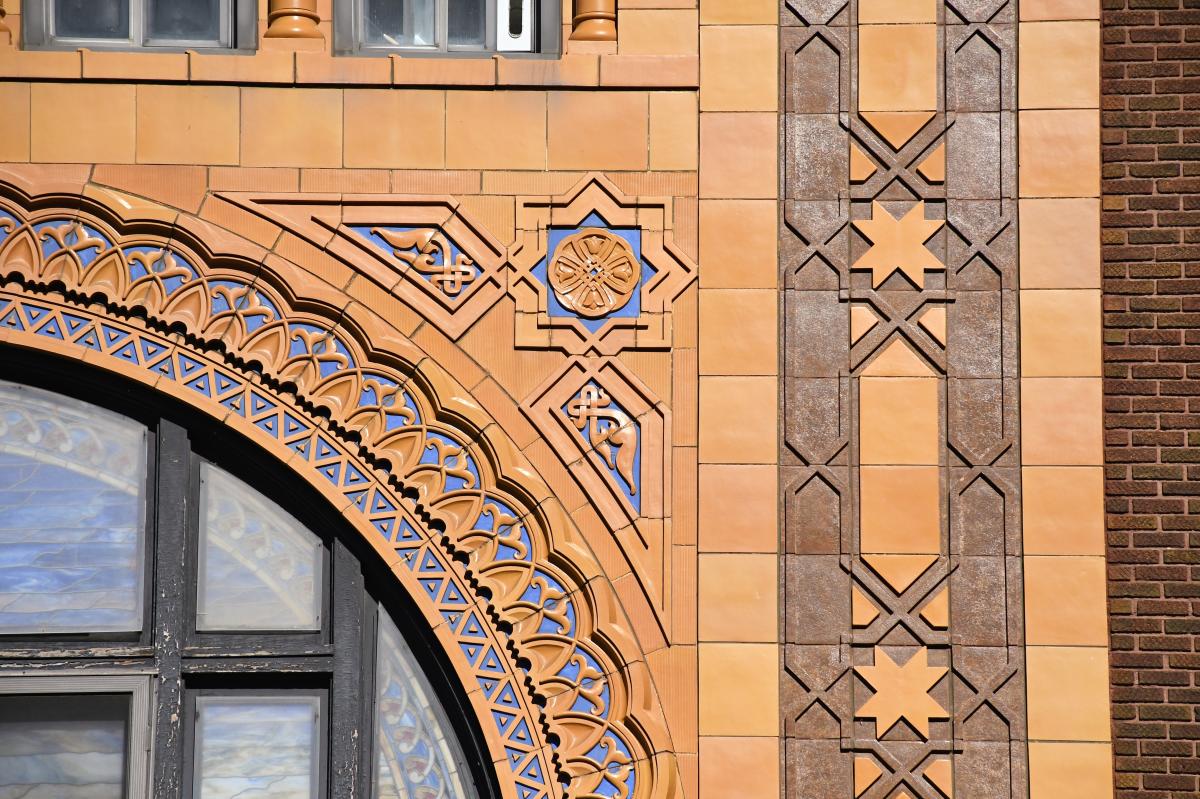
Unique details abound at the Shrine Mosque.
Route 66 was born in Springfield on April 30, 1926 when a telegram was sent from downtown Springfield to Washington D.C. requesting the name for the famous road.
A large Rotary Club convention had drawn thousands of people to downtown Springfield – and a hub and asset for those festivities was the Shrine Mosque.
Before it was built, "Springfield could not entertain any convention bringing here more than 1,000 persons, for there was no other building located centrally which afforded sufficient size," reported the Leader on May 26, 1926. "Now, however, any organization can successfully conduct a convention here, and can bring as many delegates as they choose, and all can comfortably attend all sessions."
It was during this event that a meeting was held by several stakeholders who chose to write federal highway officials and request the name. The telegraph office from where the message was sent was just a few feet away from the Shrine Mosque.
Want to learn more?
Click here to connect with the Shrine Mosque.
Resources
“$300,000 mosque to be built here by Abou Ben Adhem Shrine will be one of the largest in the U.S.,” Springfield Leader, Feb. 13, 1921
“Complete art windows for Shrine home,” Springfield Republican, Oct. 12, 1923
“Elvis Presley’s TCB Band Has Springfield Roots with John Wilkinson,” The History Museum on the Square, accessed Nov. 19, 2025
“Guitar man for the King returns to hometown,” Mike O’Brien, Springfield News-Leader, June 4, 2006
“History shines through Springfield's Shrine Mosque,” Kaitlyn McConnell, Ozarks Alive, Feb. 14, 2016
“Shrine Mosque,” National Register of Historic Places, accessed
More Resources


Itineraries
Explore curated itineraries featuring attractions, dining, entertainment, and...
Visit Page