


Springfield’s Gillioz Theatre is built with bricks and the stories of generations. It was 1926 – 100 years ago, and the same year when Route 66 was “born” just steps away – when the downtown Springfield landmark came to be.
“The opening of the new Gillioz Theatre, one of the most magnificent structures of its character in America, marks the beginning of a new era in the advancement of Progressive Springfield,” proclaimed an ad, signed by local businesses, in the Springfield Republican upon its opening.
Despite its grand beginning, the theater fell into disrepair in the 1970s and ‘80s. By the early 1990s, it wasn’t just headed nowhere good – it was already there. About 50 years of memories were set to dissipate into the past as the vacant theater was closed and rapidly deteriorating.
But dedication made the difference. Thanks to a few local folks who believed it could rise again, it did.
And today, 20 years past that rebirth, the historic Gillioz soon marks the first day of a new beginning: A second century that links Springfieldians past and present, and a present-day reminder of the power of the arts.
“What I care about is creating a space where you can be safe and where you'll see respect and kindness and the exchange of ideas in a positive way,” says Geoff Steele, the Gillioz’s executive director.
How the Gillioz Theatre began
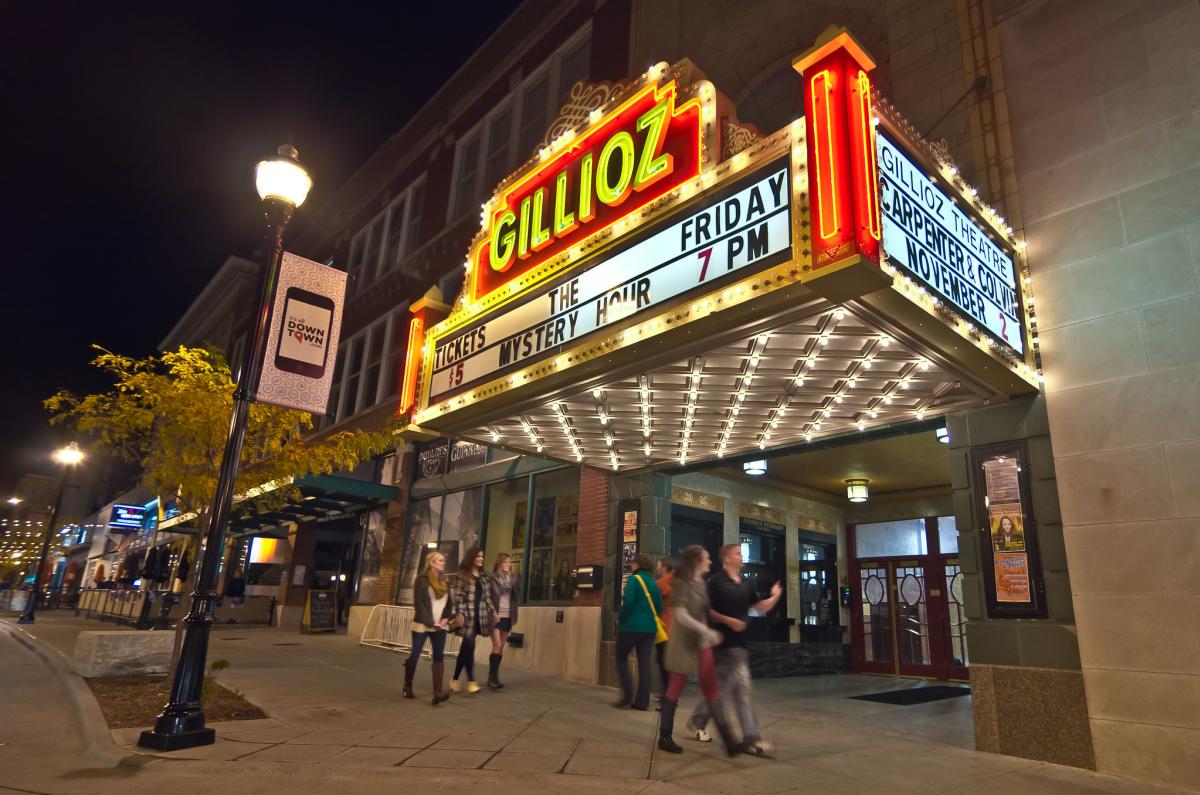
The 1920s were a busy time for St. Louis Street, the downtown Springfield thoroughfare alongside which the Gillioz shines.
It was a time of development: In 1923, the Shrine Mosque – said to have one of the largest stages west of the Mississippi River – was completed. In April 1926, during the busy hub of a Rotary convention, a telegram was sent from a nearby office to Washington D.C. asking the federal highway from Chicago to Los Angeles be named Route 66. (As we know now, they said yes.) And a few months later, it’s where the Gillioz officially opened.
It’s named for M.E. Gillioz, its builder. He wasn’t the original leader – the idea was proposed by Frank Headly, a local promoter and real estate man – but it was Gillioz who ultimately led the project to completion. He was well-known for his construction work in Springfield and beyond (including Monett, his hometown as of 1914 and where another Gillioz Theatre carried his name).
As a 1928 Springfield Daily News article put it, the builder “probably has had more to do with road, bridge and office building work in the Ozarks region the past 20 years than any other individual.” Other Gillioz projects include the Benton Avenue viaduct (now known as Martin Luther King Jr. Bridge), Fellows Lake and Jarrett Middle School (today’s Reed Academy).
The new Springfield theater, however, was unusual and in the spirit of Gillioz’s can-do attitude.
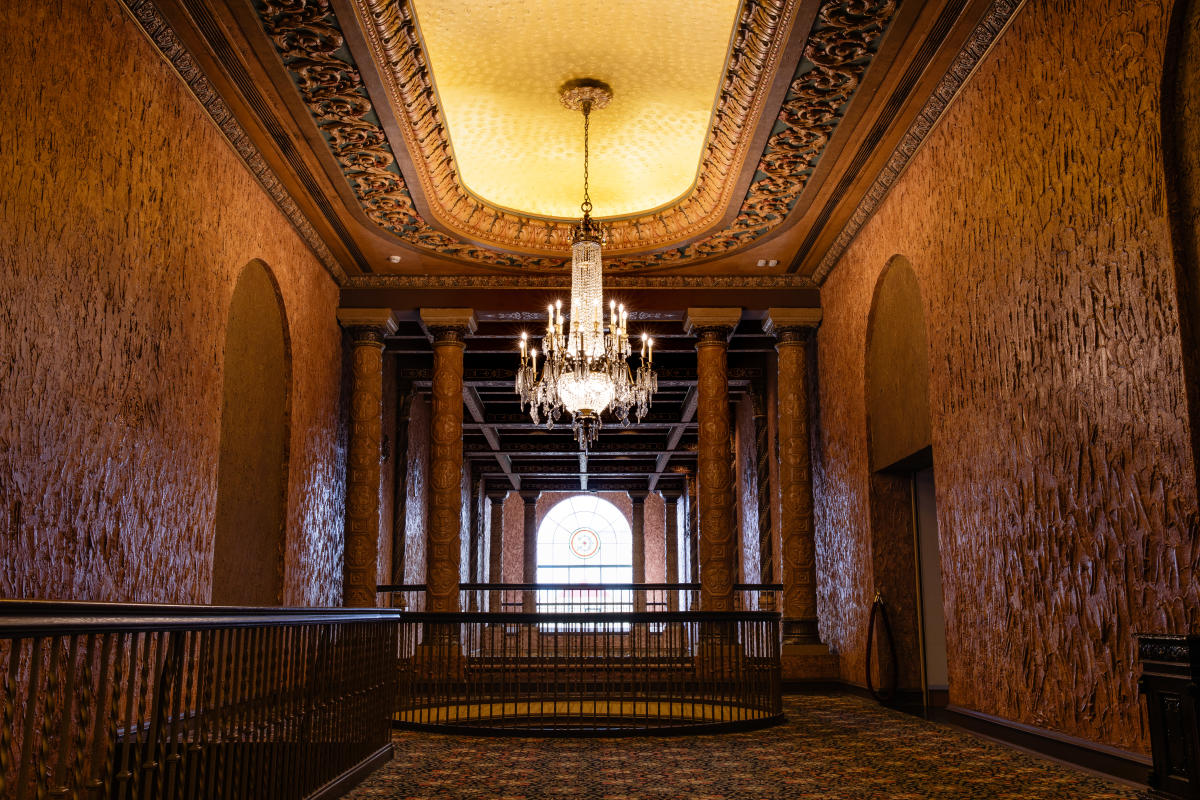
Land on what would become Route 66 was too small to build a theater. So instead of building it all on the street, the entrance was constructed fronting St. Louis Street. Then a long foyer leads visitors to the theater itself, with the auditorium backing up to Olive Street one block north.
The design was unique, officially described as Spanish Colonial Revival in its application for the National Register of Historic Places.
“Beautifully tinted walls, exquisite tapestries and elaborate pillars, with a blue and gold color scheme, make up the main entrance,” recorded the Springfield Leader on Oct. 10, 1926. “Overlooking the main lobby is the promenade, which is also elaborately decorated along the same lines as the lobby. The lobby, promenade and foyer will be handsomely appointed in expensively designed furniture, carrying out the general scheme of decorations.”
Finally, opening night arrived. The lineup – which was given twice that opening evening – included the films “Take It From Me,””Felix” and an International News Reel, noted the Springfield Leader. It continued: “In addition to the picture program will be presentations of musical extravaganzas, dancing and other features, also music by the Gillioz orchestra, and selections by Glenn Stanbach, the singing organist.”
And it would appear that evening was a success.
“One of the largest crowds ever seen on Springfield’s streets packed and jammed St. Louis Street early last night, which marked the formal opening of the new Gillioz theatre,” printed the Leader. “The house was opened at 6 o’clock, but long before that time the crowd began to gather, and long lines formed in each direction from the box office, extending for more than a block.”
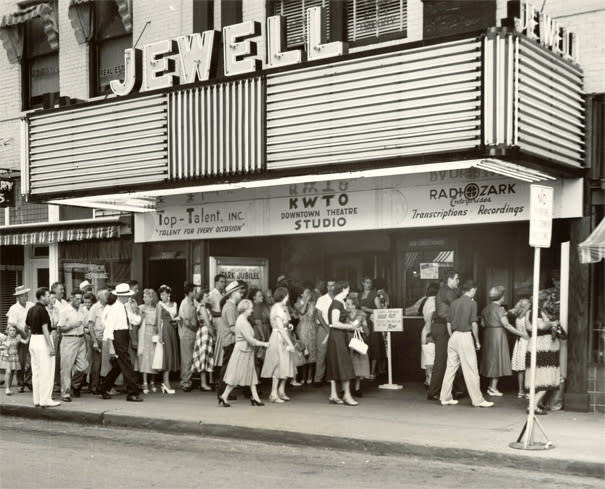
People lined up to see a show at the Jewell Theater. Photo courtesy of Visit Springfield, Missouri.
The theater, which showed movies and hosted live entertainment, joined a growing lineup of downtown Springfield venues in that era. The Landers Theater – opened in 1909 and today home to Springfield Little Theatre – was just two blocks south. Another was the long-gone Jefferson Theater, located a block south of St Louis Street on Jefferson Avenue. In its later years, the Jefferson was known as the Jewell Theater and was home to the nationally known “Ozark Jubilee” TV show.
Yet at least one nearby theater didn’t see the Gillioz as a threat: “The Gillioz Theatre is a credit to our city,” noted an advertisement in Springfield Republican newspaper placed by management of the Electric Theatre a block west on the Public Square. Today, that landmark is known as the historic Fox Theater and is part of the History Museum on the Square.
Changing times
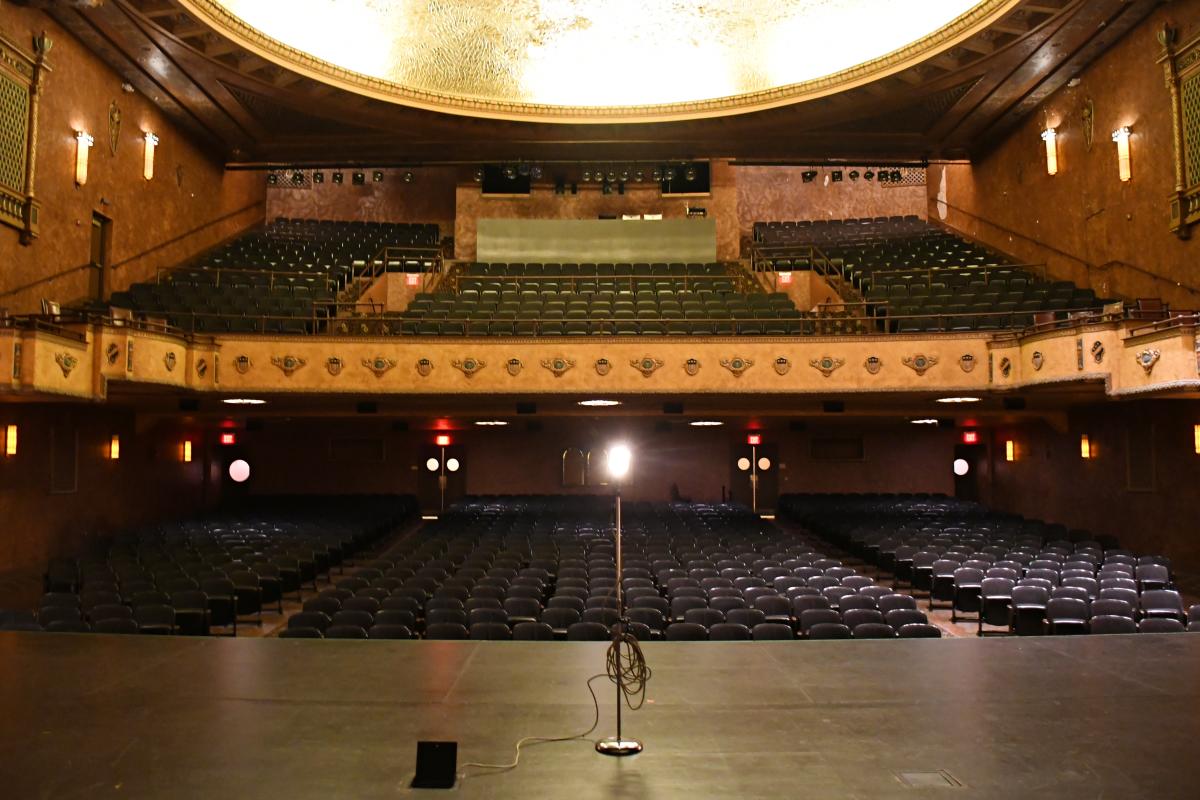
The Gillioz Theatre seats more than 1,000 patrons.
Gillioz owned his namesake theater in Springfield until 1948. That year, he sold it – but not the lobby access – for $105,000 to Fox-Midwest Amusement Corporation, which operated a number of theaters across the region.
“The demand for movies and the high costs of producing live shows encouraged the Gillioz to solely show movies by the 1950s, causing the Gillioz to lose its legitimate theater status, though Springfieldians did not seem to mind it at the time,” notes an article from the Springfield-Greene County Library District.
It was part of a heady time in downtown Springfield and at the Gillioz.
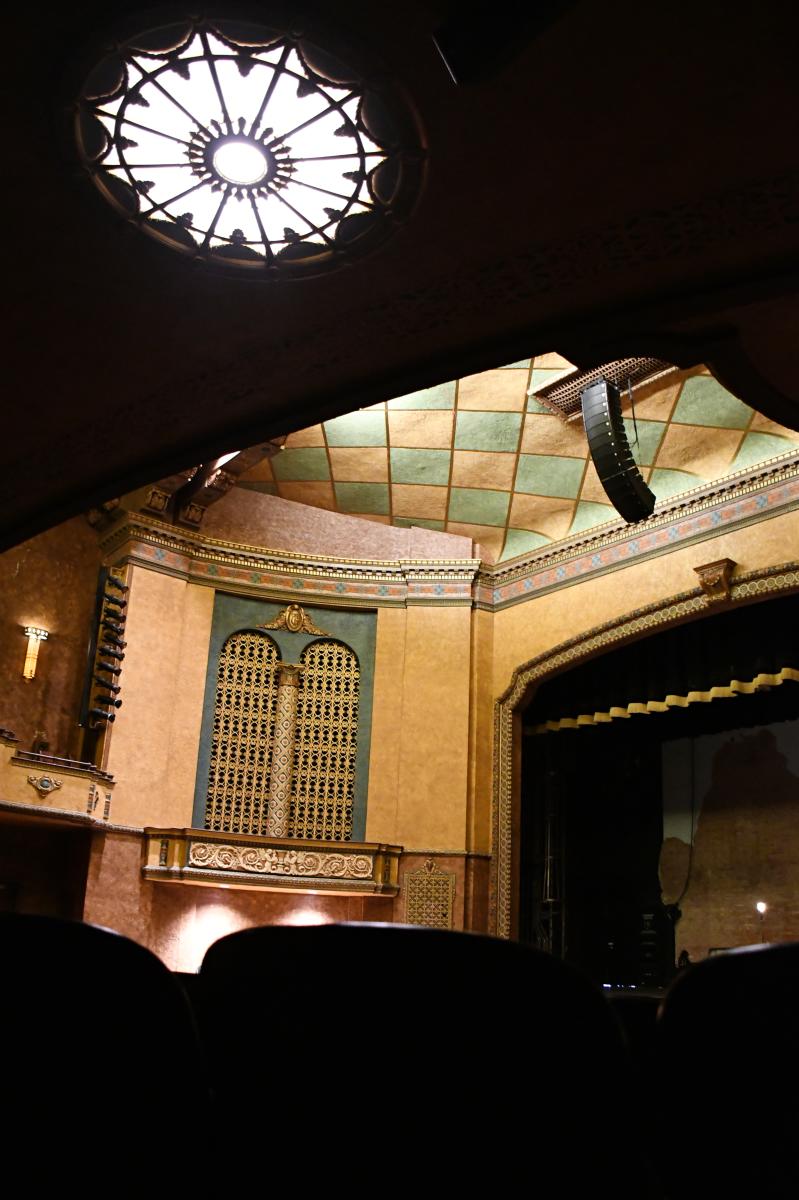
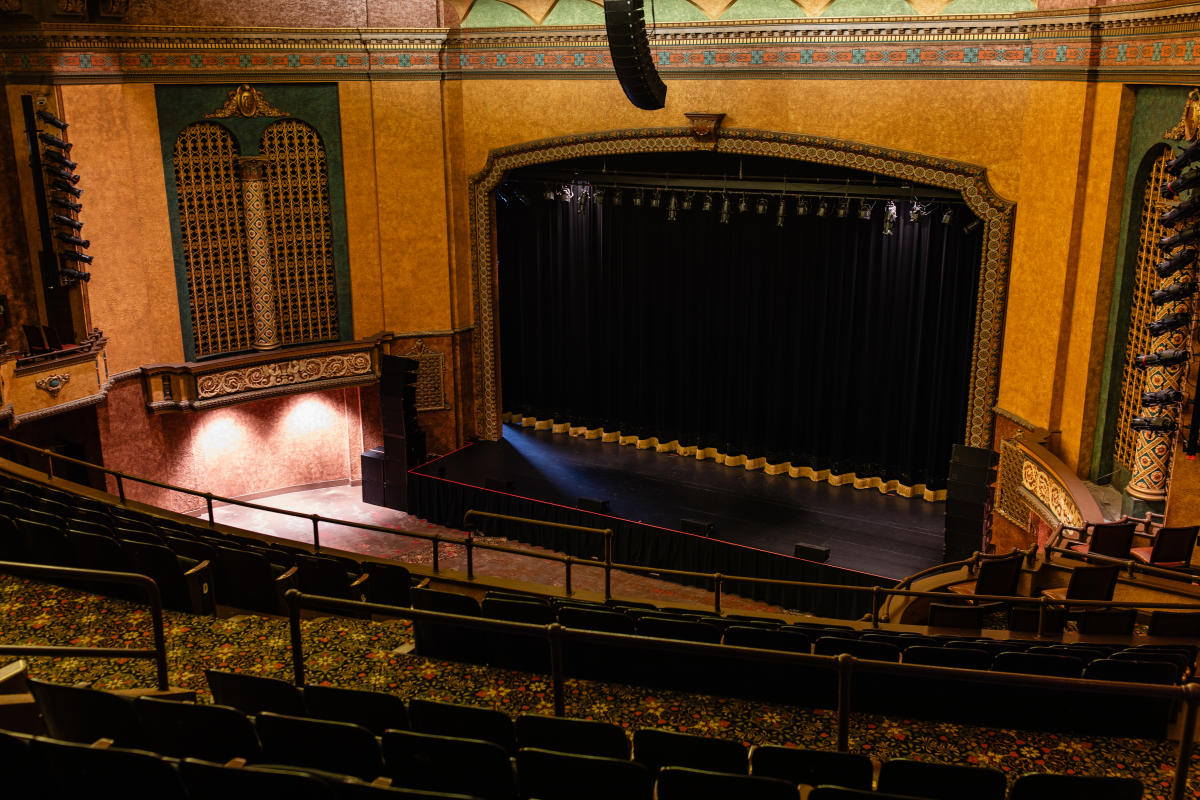
Colorful details abound in the Gillioz Theatre.
In the 1950s, Elvis watched a Glen Ford western movie from one of its seats while in town for a performance at the Shrine Mosque; future U.S. president but then-actor Ronald Reagan arrived at the theater for one of his films. Another time, Clark Gable sent a telegram to the Gillioz when one of his films premiered. Years before, the color film "Jesse James," starring Tyrone Power, Henry Fonda, Randolph Scott and Nancy Kelley, hosted its world premier at the Gillioz in 1939 — it was filmed in Pineville, the seat of McDonald County, Missouri.
However, it should be noted: As with many locations in downtown Springfield, not all people were able to enjoy the Gillioz. Only white patrons were allowed there into the 1960s, its National Register application notes.
By the late 1970s, downtown Springfield was in decline as the city pushed south. The theater’s famed pipe organ, installed when it opened, was sold in 1979. In 1980, the newly formed Springfield Regional Opera performed “La Traviata." At the time, SRO debated purchasing the property but did not. That same year, the Gillioz sold to the Dickinson movie theater company and was closed.
“We just locked the doors and left it the way it was,” said Bill Burnett, Dickinson area manager, through the Springfield Leader and Press in November 1981. “It’s strange, you know — but when you close those old theaters up, they begin to fall apart. There’s something about not having people in them, even if there’s no real destruction of the place. The plaster starts to go and before long they start to crumble.”
And, for years, that is indeed what happened.
The turn of the ‘90s led to increasing conversations around change. Nancy Maschino Dornan, who has preserved many properties in Springfield, met with businessman Sam Freeman and architect Laura Derrick amid dead pigeons, needles, broken bottles and oil drums – used by unhoused individuals to stay warm – that littered the interior of the decaying landmark.
“The three of us stood in that godforsaken, nasty, outer lobby, looked at each other and said, ‘If we don’t do it, nobody’s gonna do it,’” Dornan told Ozarks Alive in 2016.
It ultimately was purchased by Jim D. Morris and other members of the community in 1990, notes information from Missouri State University Libraries. A year later, the nonprofit Springfield Landmarks Preservation Trust was formed and began planning the Gillioz’s restoration.
Work progressed slowly but effectively. In 1991, National Landmark status was achieved; SLPT took possession of the theater in 1992. Six years later, the next-door former Netter’s department store was also acquired to expand the center’s footprint.
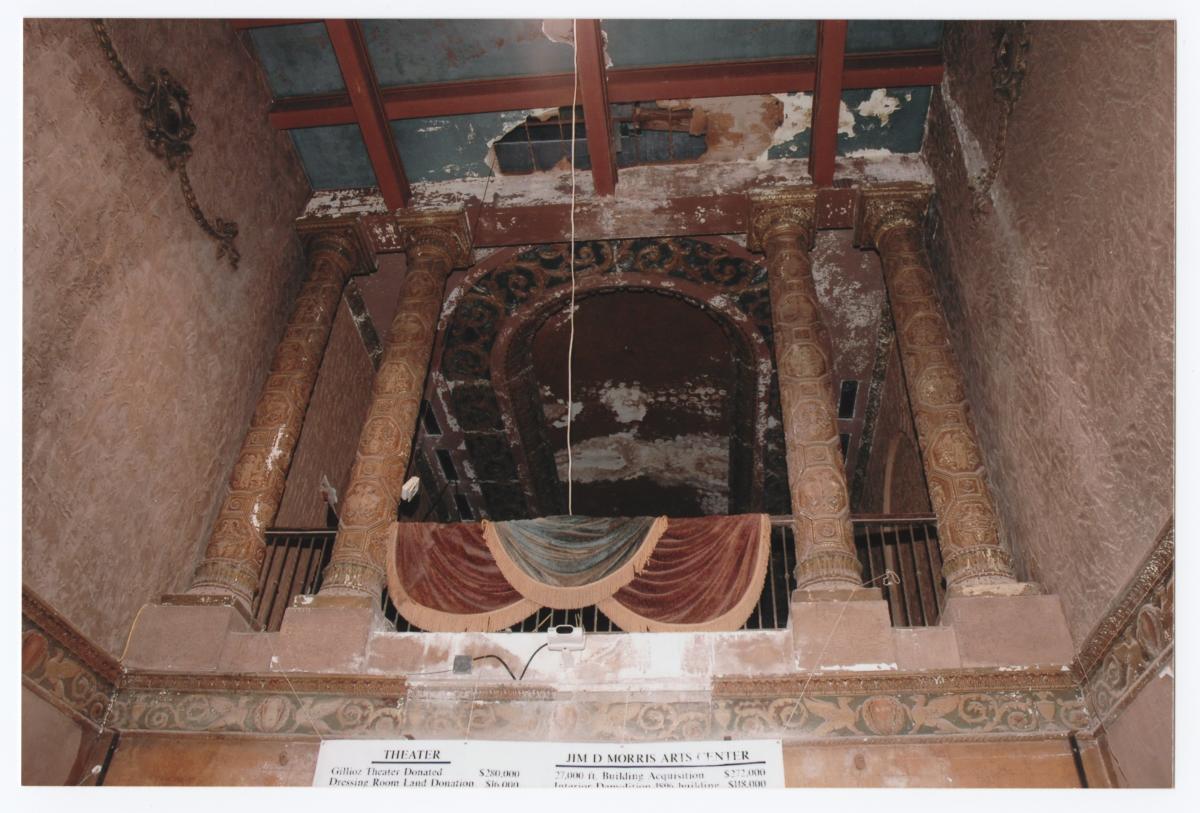
Restoring the Gillioz Theatre took more than 15 years. Here, part of the entry lobby is shown circa 2006. (Courtesy of the Springfield-Greene County Library District/David Eslick Collection)
Those collective efforts led to a milestone moment in 2006, when the theater reopened to the public.
“After 16 years of work, the belle of downtown will reopen its doors,” the Springfield News-Leader proclaimed.
The Gillioz at a Century
The Gillioz’s centennial is cause for celebration because it means it’s still here, despite the challenges over that century of change – including after its reopening.
Four years after its rebirth, financial challenges led the theater to nearly be sold. It reorganized, but was put up for auction again in 2013. This time, the theater was purchased by Robert Low, the owner of Springfield-based Prime Trucking, who ultimately deeded it to the theater operators.
Then came COVID.
During the pandemic, the theater was completely closed for a time, which was followed by a partial occupancy. Other theaters in similar situations didn’t survive, Steele says. Things were very uncertain.
He shares that during the pandemic, he would go into the empty theater and just sit.
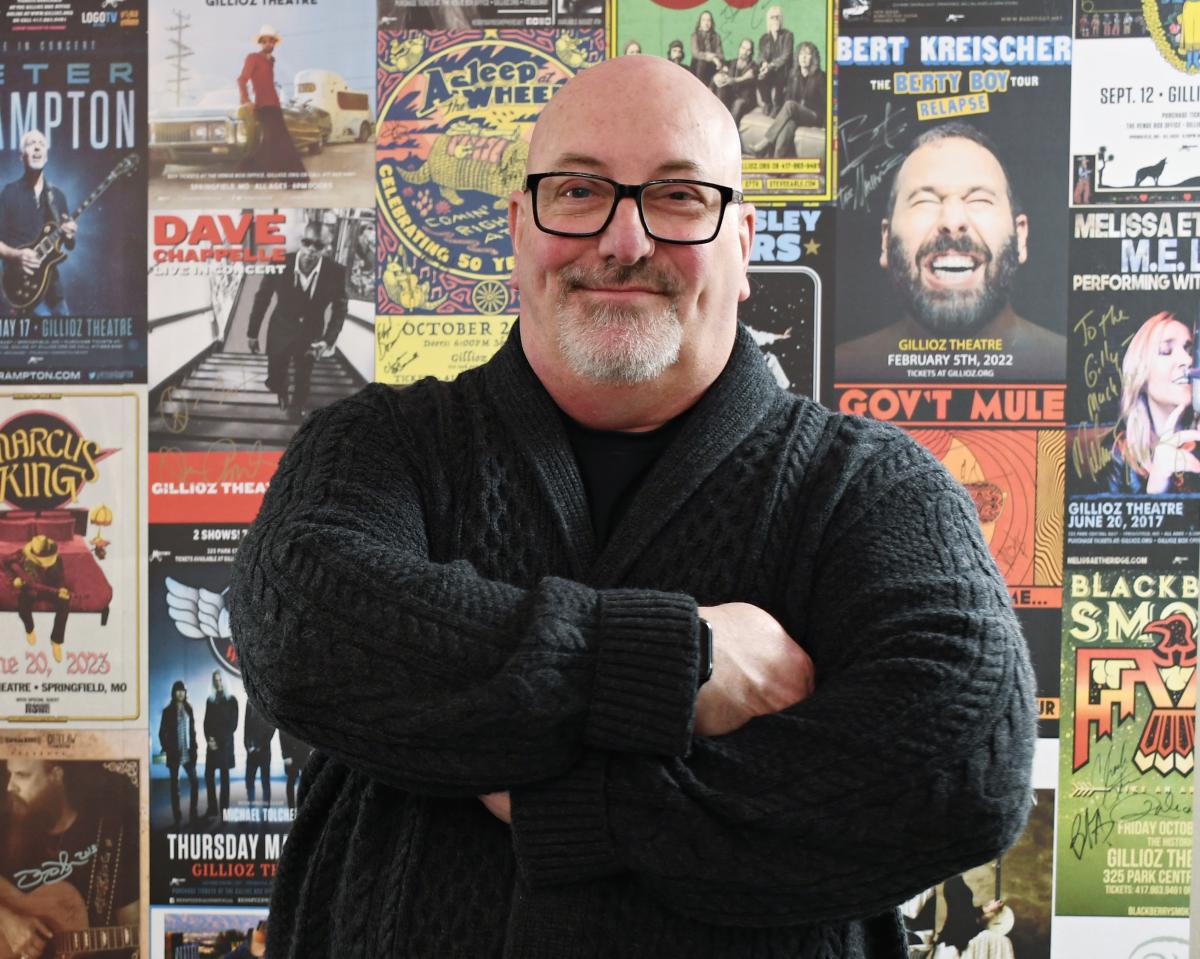
Geoff Steele is executive director of the Gillioz Theatre. He has been in the role since 2014.
“I would just let the room do what it does,” he recalls. “I would always go along and run my hand on the back seats, and I'd say, ‘I promise you, we'll get them back. I promise they'll come back.’ But we weren't sure that they would.
“At that point, we were like, ‘Will people be afraid to come back to mass gatherings? Will general admission shows ever exist again?’”
Thankfully for Steele, they did. Yet the financial reality was still challenging – leading Low to acquire the theater a second time, and then lease it back for its current use.
Even as the world moved past the pandemic, the questions it provoked remained.
“I believe out of necessity we really had to evaluate not only who we are but why we are,” Steele says. Through those moments, Steele came to an even deeper focus on advocacy: For the Gillioz, for collaboration and for the arts as a whole.
“(The arts is) worth more to our gross domestic product than transportation or agriculture,” Steele says of the United States. “Now, think about that. On the President's senior staff, there's a Secretary of Transportation, there's a Secretary of Agriculture – there's no Secretary of the Arts, even though it's worth more money to the bottom line. So this isn't about being a liberal or conservative. It's about being a smart business person and about being socially responsible. We really began to advocate for that.”
And part of that mission takes the Gillioz back to its start at the hands of a bridge-builder. This time, however, those links aren’t literal: They’re connections with others, fostered alongside the wide-ranging shows and talent visitors can see on the theater’s stage.
Two years ago, the Gillioz added offices for arts-focused nonprofits on its third floor. Those spaces allow efficiency for entities that need an office but not much space, and offers the benefit of proximity.
“My mission is to destroy the silos, and that's part of why the third floor exists, right?” says Steele, speaking from a conference room on that floor. “We just passed, coming into this room, the Ozark Lyric Opera. We passed the Missouri Jazz Orchestra. We passed the Mosaic Arts Collective. We passed the Southwest Missouri Film Office. We passed SATO48. We passed all these nonprofits that are arts organizations that are collaborating proactively.”
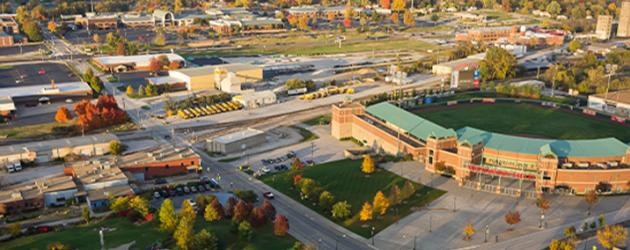
That collaboration extends down the street — in both directions — as the Gillioz now manages the historic Fox Theatre as well as soon-to-come entertainment at Hammons Field. To Steele, that type of cohesion helps Springfield grow its arts scene in a meaningful way.
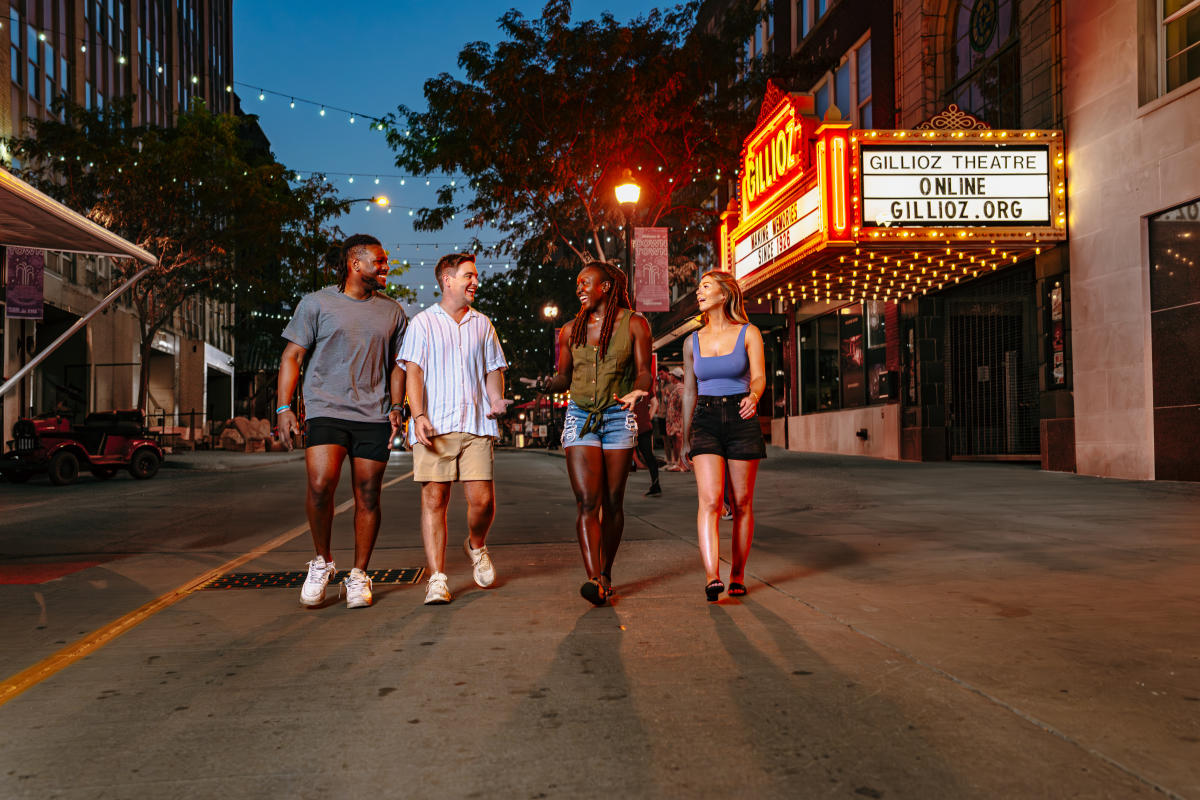
The Gillioz Theatre Today
“In my opinion, we've spent an enormous amount of money and time talking about ‘We've got to figure out what Springfield Missouri is,’ and I'm sitting here simply saying, ‘This is not hard. This can be answered in about 30 seconds. Are you ready?” he says.
“Go back 100 years and look at what our forefathers gave us when they built the Shrine Mosque, and when they built the historic Gillioz Theatre and the historic Fox and the historic Landers, all within walking distance. They … said, ‘Our grandchildren have the infrastructure and the tools to prosper their downtown with these investments.’”
Want to learn more?
More Resources


Itineraries
Explore curated itineraries featuring attractions, dining, entertainment, and...
Visit Page